
Practical Vision Analytics
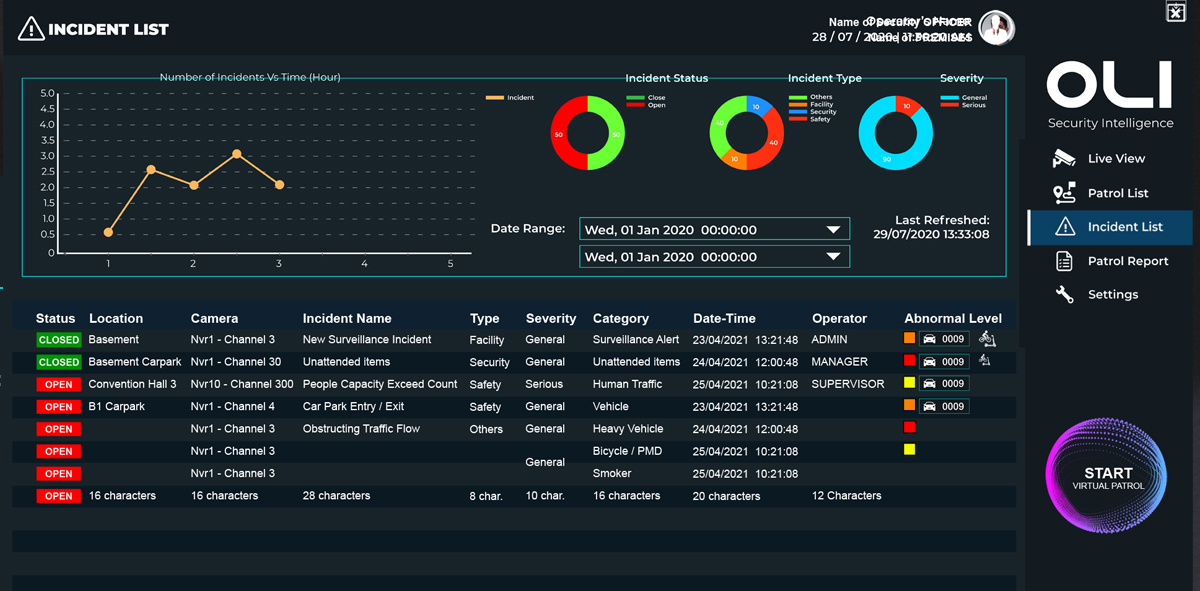
The OLI technology is a hardware agnostic software designed to improve the productivity of Security Professionals through the use of proactive detection and digital capabilities.
The Virtual Guard Technology (VGT), creates a verified, and auditable medium to drive conventional patrolling without physically walking the grounds.
This technology can be deployed both on premise and applied remotely.
AI-driven
Surveillance Systems
Modern security solutions, like AI-driven surveillance systems such as aDA Trained Detection, revolutionize premises clearance. They automate the process, eliminating the need for manual patrolling and reducing labor requirements. Real-time crowd density monitoring with AI-powered analytics helps manage crowd flow during peak hours or events. These systems provide accurate and up-to-date information at the command centre, enabling swift responses to security incidents and enhancing overall security measures. Embracing these modern solutions transforms security operations, ensuring safer and more secure environments for all.
Features "Empowering Smart Security with ADA's Intelligent AI"
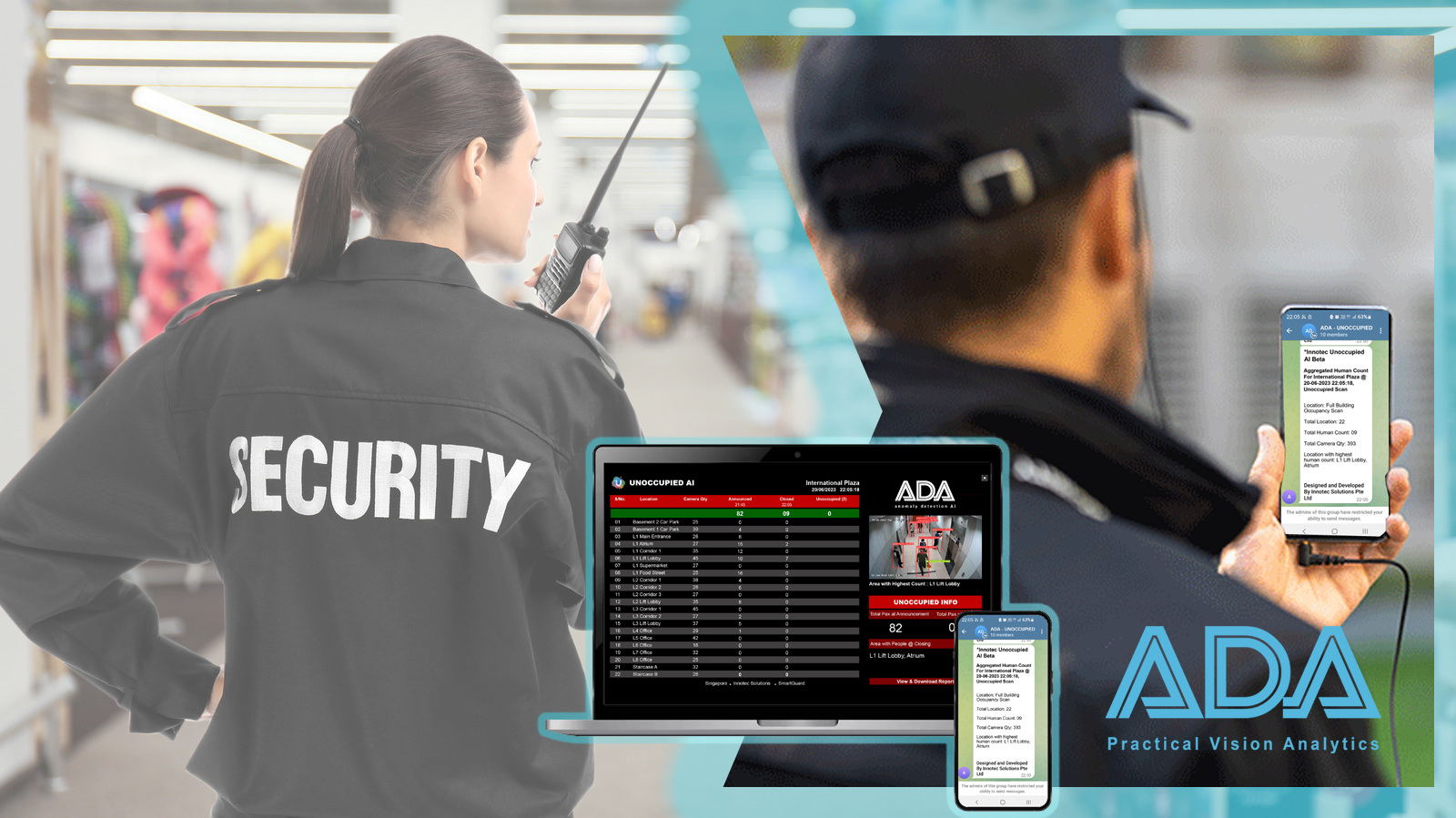
- ADA’s practical vision analytics accurately detects human presence in any CCTV scene without complex configurations or additional hardware.
- Empowers security managers with real-time human count and location statistics, ensuring secure building clearance after closing time.
- Integration with mobile phones provides instant alerts on human presence and detected locations for swift action.
- Streamlines security operations by eliminating the need for labor-intensive physical checks.
- Enhanced building occupancy monitoring through consolidated real-time information on a single screen.
- ADA’s intelligent AI sets new standards for smart security, optimizing surveillance and enhancing efficiency in protecting occupants and premises.
MAKE THE CHANGE TO ADA
Upgrade to ADA AI Powered Security Software
- Ada: ADA uses proprietary parallel processing technology to supercharge conventional video analytics, obviating the necessity of relying on GPU acceleration.
- Detect Human & Location: The software’s ability to identify humans and their locations in a CCTV scene.
- Automatically update Command Centre: The software’s ability to send real-time updates to the Command Center, which is a central location where security personnel can monitor CCTV footage and respond to incidents.
- Simultaneously: The alerts are sent to the officers on the ground at the same time that the updates are sent to the Command Center.
- All Officers on the ground: The software sends alerts to all officers who are currently on duty and patrolling the premises.
- Mobile App: The software sends alerts to the officers’ mobile apps, which allows them to receive the alerts quickly and easily.
Technology can make security guards more efficient, productive, and reduce the number of guards needed to patrol premises.
The problems with conventional patrolling can be solved by using smart patrolling or AI-powered software. These solutions can help to improve the efficiency and effectiveness of security patrolling, and they can also help to prevent security breaches.
In addition to the problems mentioned above, conventional patrolling can also be subjective and error-prone. Security guards may miss people or unauthorized activity, or they may misinterpret what they see. This can lead to security breaches and other problems.
Conventional patrolling can be effective in deterring crime and preventing security breaches. However, it has a number of limitations, including:
- It can be time-consuming and inefficient.
- It can be subjective and error-prone.
- It cannot provide real-time information about the status of a property or area.
Smart patrolling and AI-powered software can help to address these limitations. These solutions can automate some of the tasks of patrolling, provide real-time information, and be more objective and accurate than human guards.
FAQ
Add Your Heading Text Here
Can our system be used to control overcrowding?
Yes, it can be used to provide information of the number of people in the premise. As long as the camera is able to identify the human, it will provide the count.
Is the video recorded?
No, ADA only retrieves meta data from the video feeds to provide the necessary information. Video footages will be stored locally on the HDD of the DVR / NVR system on site. As such there is no concern to PDPA / GDPA.
How does this system work and how do I view?
ADA Fire Evacuation Module software will need to be installed on a new or existing workstation / laptop to be provided by customer or distributor.
The workstation / laptop will then be connected via network cable to the DVR / NVR / Network Switch.
Telegram? Who will be in the group chats?
Key personnel involved will be added in the group chat. E.g.; CERT team, Security Manager, Fire Safety Manager, Fire Wardens, SCDF Personnel on site, ETC.
Is the telegram report a visual or just a report?
It is a channel to give “LIVE” updates on the situation of the fire evacuation. PDF reports can be generated from the work station.
How long does it take to train the AI?
The AI does not need specific training, it is plug and play. Only for specific situations, we might need to further improve the performance with more training.
How long is the integration process?
It will depend on the number of cameras assigned to be activated as well as correct IP information provided with location details. E.g.; 32 cameras would take under 2 hours to integrate.
What type of cameras can work with this system?
This system will work with all types of Analog or IP CCTV cameras.
Add Your Heading Text Here
Can ADA be used for spotting smoke & fire?
New dataset models like smoke and fire can be trained but we will need the video resources and information from SCDF to train our AI as such information is normally not available to the private sector.
How do you know which floor have bottleneck?
By the sessions that we are running, if the count constantly increases and doesn’t decrease gradually, it might be a sign of a bottleneck occurring.
What is the con op of this technology?
We would need S(..)’s constant inputs on the command ops workflow to further improve ADA’s technology.
Is the system able to track responder movement and location? How does it differentiate between public and responder?
At this point of time the system is unable to differentiate as it does not have images of Fire Fighter Gear and Equipment for the system to train. We would be willing to work together with authorities to train the system to differentiate.
Are we able to tell if someone is unable to move and needs medical attention / assistance?
If the system is showing a count of persons at a certain level after a few sessions, it would be safe to assume that the person(s) may require assistance. CCTV camera footage may be used to ascertain the situation.
Where else has ADA Fire Evacuation module been deployed?
ADA Fire Evacuation module was created less than 1 month ago and International Plaza is our first technology partner showcase with the desired outcome to use technology to mitigate against PWM and deficit in security manpower (Current shortage of approximately 20,000 in security guards)
How much is the system?
Depending on the number of cameras assigned to be activated, yearly subscription will start from as low as S$1,600 a year for a 1-8 cameras solution.